
 Call Us
 Enquiry now
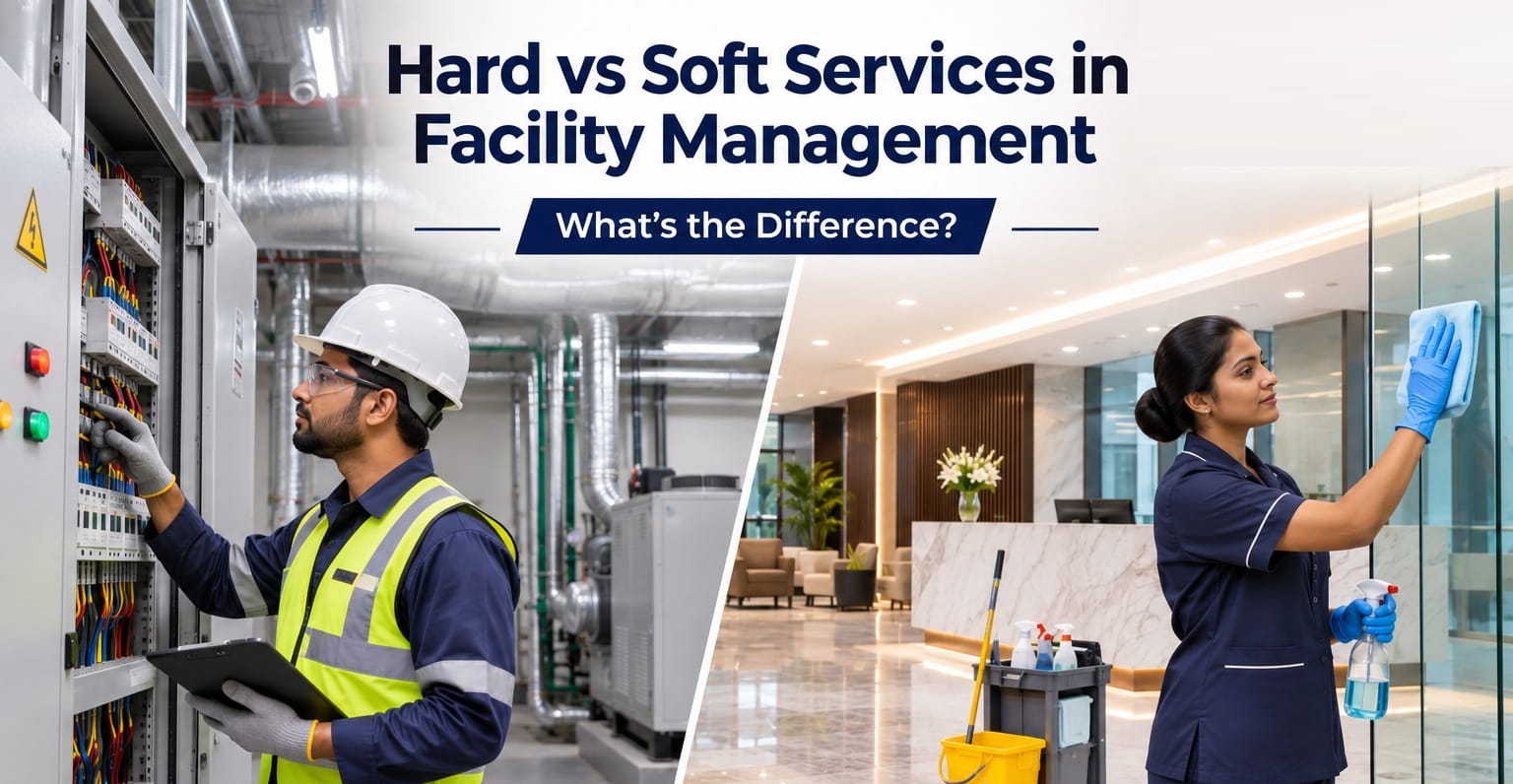
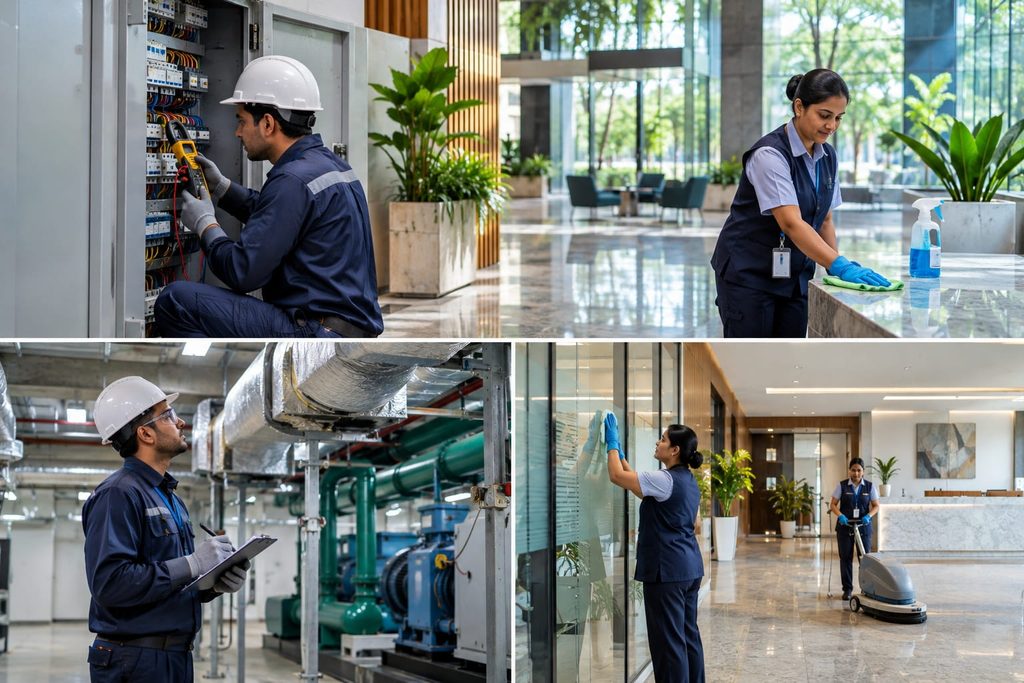
Hard and soft facility management services in a commercial building
Think about a typical day in a commercial office building. Before employees arrive, the housekeeping team cleans the workspaces, washrooms, and common areas. Meanwhile, maintenance technicians check the air conditioning, electrical systems, and other equipment that keeps the building running.
Both teams are responsible for maintaining the property, but their work falls into two different categories of facility management: hard services and soft services.
Hard facility management services focus on the building’s physical infrastructure, equipment, and technical systems. Soft facility management services focus on cleanliness, hygiene, presentation, and the everyday experience of people using the building.
Understanding this difference helps property owners and facility managers plan maintenance, assign responsibilities, manage service contracts, and maintain a safer, more comfortable workplace.
Let’s look at what each category includes, how they differ, and why commercial properties need both.
What Are Hard Facility Management Services?
Hard facility management services involve the maintenance, inspection, repair, and operation of a building’s physical assets and technical systems.
These services help ensure that essential building equipment functions properly and that infrastructure remains safe and suitable for daily operations.
For example, an office building depends on functioning electrical installations, air conditioning systems, plumbing networks, and fire protection equipment. If any of these systems fail, normal business operations may be affected.
Hard services are generally handled by technicians, engineers, and other trained maintenance professionals.
Common Examples of Hard Facility Management Services
1. Mechanical, Electrical and Plumbing (MEP) Services
Mechanical, Electrical and Plumbing services cover the essential infrastructure that supports a building’s daily functioning.
This includes electrical distribution systems, water supply networks, drainage systems, mechanical equipment, and associated installations.
An electrical fault or plumbing breakdown can interrupt business operations and create safety concerns if not addressed promptly.
Regular inspections, preventive maintenance, and timely repairs help facility managers identify potential issues and maintain reliable infrastructure.
Casa Grande PropCare provides MEP services to support the maintenance and operation of mechanical, electrical, and plumbing systems in commercial facilities.
2. HVAC Maintenance
Heating, Ventilation and Air Conditioning (HVAC) systems help regulate indoor temperature, ventilation, and air circulation.
Regular servicing of air conditioning units, chillers, ventilation equipment, and related components helps maintain system performance and identify faults before they become major problems.
In a busy office building, an unexpected air conditioning failure can affect employee comfort, disrupt meetings, and interfere with daily activities.
Planned HVAC maintenance helps reduce the likelihood of avoidable equipment breakdowns.
Explore Casa Grande PropCare’s HVAC services to understand how technical maintenance supports commercial buildings.
3. Operations and Maintenance Services
A building requires ongoing attention even when its systems appear to be functioning normally.
Operations and maintenance teams carry out scheduled inspections, preventive maintenance, equipment monitoring, and repairs based on the facility’s requirements.
This includes monitoring critical installations, identifying equipment faults, coordinating technical repairs, and maintaining service records.
A planned maintenance programme can help reduce avoidable breakdowns and extend the useful life of building assets.
Learn more about PropCare’s operations and maintenance services for commercial and industrial properties.
4. Fire and Safety System Maintenance
Fire alarms, sprinkler networks, fire pumps, and other protection systems require appropriate inspection, testing, and maintenance.
These activities are important for maintaining system readiness and supporting applicable safety requirements.
Regular maintenance also helps identify issues involving damaged equipment, faulty components, or systems that may not operate correctly during an emergency.
5. Building Management Systems (BMS)
Building Management Systems help monitor and control selected building operations, such as HVAC, lighting, and other connected equipment.
Maintaining these systems allows facility teams to identify faults, monitor performance, and respond to operational issues more effectively.
Why Are Hard Services Important?
A building can look clean and well-maintained while still having serious technical problems.
An overloaded electrical installation, leaking pipe, or poorly maintained air conditioning system may not be immediately visible to employees.
Hard facility management services address these risks through appropriate inspections, maintenance schedules, repairs, and technical supervision.
Their main purpose is to keep the building’s physical systems safe, functional, and reliable.
What Are Soft Facility Management Services?
Soft facility management services focus on maintaining a clean, hygienic, organised, and welcoming environment for employees, visitors, and other building occupants.
Unlike hard services, which primarily deal with technical infrastructure, soft services are closely connected to how people use and experience a property every day.
Consider a busy corporate office. Even when the air conditioning and electrical systems are working perfectly, overflowing waste bins, unclean washrooms, or poorly maintained common areas can affect the workplace experience.
That is where soft services become essential.
Common Examples of Soft Facility Management Services
1. Housekeeping and Janitorial Services
Housekeeping is one of the most visible soft services in a commercial property.
It includes cleaning floors, maintaining washrooms, caring for workspaces, cleaning common areas, and following routine hygiene schedules.
In larger properties, cleaning requirements may differ between office floors, cafeterias, reception areas, warehouses, and other operational spaces.
Casa Grande PropCare provides housekeeping and janitorial services for commercial and industrial facilities, with cleaning activities planned around individual site requirements.
2. Pest Control Services
Pest control helps businesses manage problems involving rodents, insects, and other pests that may affect workplace hygiene or damage property.
For example, a commercial cafeteria may require a different pest management programme from an office workspace or warehouse.
Regular inspections, preventive measures, and appropriate treatment methods help reduce infestation risks.
Find out more about Casa Grande PropCare’s pest control services.
3. Landscaping and Horticulture
Outdoor spaces also contribute to the overall condition and presentation of a commercial property.
Landscaping services may include lawn maintenance, tree pruning, gardening, irrigation-related upkeep, and the care of surrounding green areas.
For commercial campuses and residential communities, consistent landscape maintenance helps keep outdoor areas organised, accessible, and welcoming.
Explore Casa Grande PropCare’s landscaping services for professional outdoor property maintenance.
4. Waste Management
Commercial properties generate different types and volumes of waste depending on their activities.
Waste management services support collection, segregation, handling, and coordination of disposal activities according to the waste streams and applicable requirements.
5. Guest House Management
Corporate guest houses and accommodation facilities require regular upkeep and day-to-day operational support.
These activities can include housekeeping coordination, room readiness, and other guest-related facility services.
Why Are Soft Services Important?
Employees and visitors may not notice a well-maintained electrical panel, but they immediately notice an unclean reception area or poorly maintained washroom.
Soft services have a direct influence on the appearance, hygiene, and everyday usability of a property.
For businesses receiving customers, clients, and other visitors, consistent housekeeping and facility upkeep also contribute to a professional first impression.
Their main purpose is to maintain the environment in which people work, visit, and carry out daily activities.
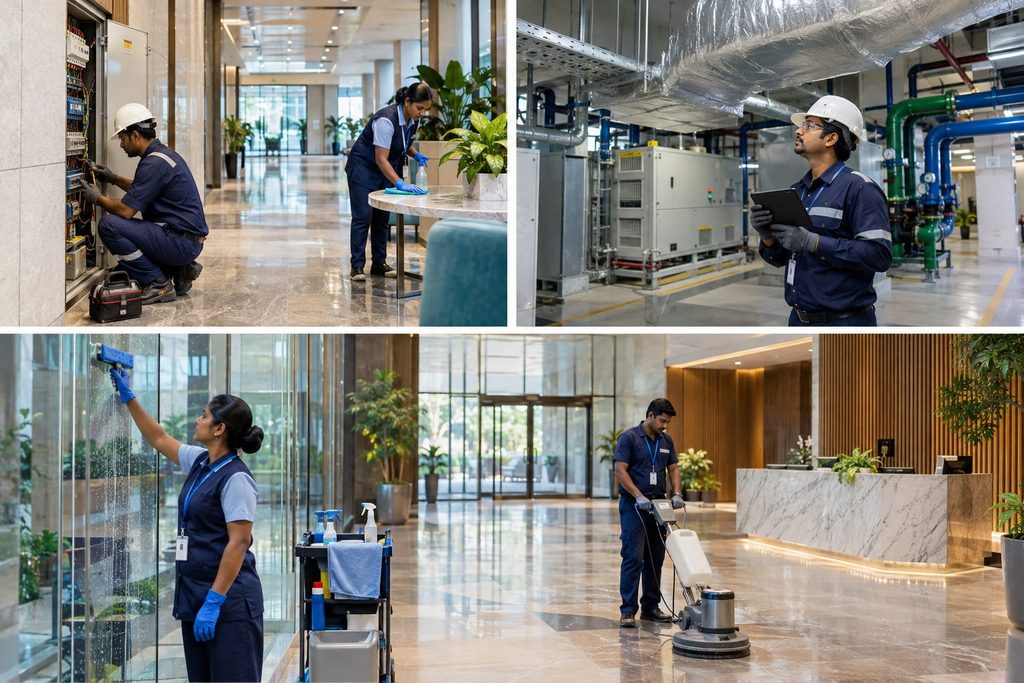
Technical maintenance and housekeeping services in corporate facilities
Hard vs Soft Facility Management Services: Key Differences
Although both categories support building operations, they differ in purpose, workforce requirements, activities, and performance measurement.
| Comparison | Hard Facility Management Services | Soft Facility Management Services |
| Primary focus | Building infrastructure and technical systems | Cleanliness, hygiene, presentation, and occupant experience |
| Main objective | Keep equipment and essential systems operational | Maintain clean, comfortable, and usable spaces |
| Examples | HVAC, electrical maintenance, plumbing, MEP, BMS, fire safety systems | Housekeeping, pest control, landscaping, waste management |
| Workforce | Engineers, technicians, and skilled maintenance personnel | Housekeeping staff, cleaning specialists, pest control personnel, and supervisors |
| Typical activities | Inspections, servicing, testing, repairs, and preventive maintenance | Cleaning, sanitisation, waste collection, pest prevention, and routine upkeep |
| Frequency | Based on equipment condition, maintenance schedules, and technical requirements | Daily, weekly, periodic, or as required by site conditions |
| Performance measures | Equipment uptime, maintenance completion, breakdowns, and response times | Cleaning quality, service completion, hygiene standards, and complaint resolution |
| Potential impact of poor service | Equipment failures, operational interruptions, and safety risks | Poor hygiene, occupant complaints, and reduced property presentation |
The simplest way to remember the difference is this: hard services maintain the building and its systems, while soft services maintain the environment people use.
The distinction is useful for planning, although certain activities may overlap or be classified differently depending on the facility management contract.
How Do Hard and Soft Services Work Together?
Hard and soft services are often discussed separately, but their daily activities are closely connected.
Consider three examples.
Example 1: Water Leakage in a Commercial Office
A housekeeping employee notices water accumulating near a washroom.
The housekeeping team can isolate the affected area, display appropriate warning signs, and inform the facility supervisor.
The maintenance team then identifies whether the leak is coming from a pipe, fitting, or other plumbing component.
After the repair is completed and the area is safe, housekeeping can clean and restore the affected space.
In this situation:
- Soft services: Identify the issue, support immediate area control, and restore cleanliness.
- Hard services: Inspect the plumbing system, identify the fault, and complete the technical repair.
Both teams have different responsibilities, but coordination between them is necessary.
Example 2: Air Conditioning Problems in an Office
Employees report that a meeting room feels unusually warm.
The housekeeping team may notice the complaint while carrying out routine activities and report it to the facility supervisor.
An HVAC technician then checks the air conditioning system, identifies the problem, and carries out the necessary servicing or repair.
The technical issue belongs to hard services, but effective reporting from the wider facility team helps it reach the right personnel.
Example 3: Pest Activity in a Commercial Building
A housekeeping supervisor notices signs of pest activity near a pantry or waste collection area.
The pest control team investigates the problem and identifies suitable control measures.
If the inspection reveals an opening around a pipe or a damaged fixture, the maintenance team may also need to carry out repairs.
This example shows how pest control, housekeeping, and technical maintenance can work together to address both the immediate issue and possible contributing conditions.
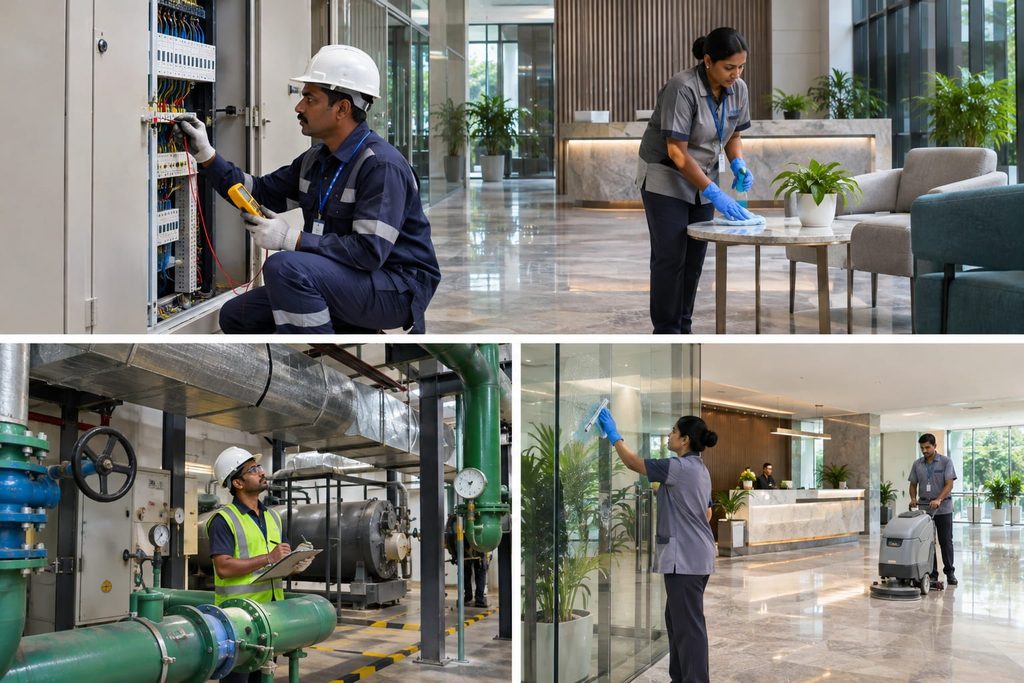
Integrated facility management covering HVAC, electrical maintenance and commercial cleaning
Why Do Commercial Buildings Need Both Hard and Soft Services?
A commercial building cannot operate effectively by focusing on only one category of facility management.
A technically sound building may still have poor hygiene standards, while an exceptionally clean property may suffer from equipment breakdowns and unreliable infrastructure.
Both situations can create problems for the people who occupy or manage the facility.
1. Better Coordination of Daily Operations
When maintenance and housekeeping activities are coordinated, facility managers can plan tasks around building occupancy and operating hours.
For example, scheduled air conditioning maintenance may require temporary access restrictions, while housekeeping can arrange cleaning activities before or after the technical work.
2. Improved Preventive Maintenance
Routine cleaning and inspections can help teams identify visible signs of developing problems.
Water stains, damaged fittings, unusual equipment noise, or recurring leaks can be reported to technical personnel for assessment.
Early reporting does not replace professional inspections, but it supports better maintenance planning.
3. A Safer and More Comfortable Workplace
Technical maintenance supports the safe and reliable operation of essential systems.
Housekeeping, pest control, and waste management support cleanliness and hygiene.
Together, these activities help maintain a workplace that is suitable for employees, visitors, and daily business operations.
4. Clearer Service Accountability
When responsibilities are documented, facility managers can identify who is responsible for each activity.
For example, cleaning an air conditioning vent’s external surface may fall within an agreed housekeeping scope, while inspecting and servicing the internal HVAC equipment requires qualified technical personnel.
Clear service boundaries help reduce confusion and ensure that specialised work is handled by appropriately trained people.
How Should Businesses Choose the Right Facility Management Services?
The right combination of hard and soft services depends on the property’s size, usage, infrastructure, and operating requirements.
A corporate office, manufacturing facility, warehouse, and residential community will not necessarily need the same service arrangement.
Before finalising a facility management contract, businesses should evaluate the following factors.
Property type and infrastructure
Identify the building’s technical systems, operating equipment, common areas, and maintenance requirements.
Occupancy and operating hours
A property operating around the clock may require different staffing arrangements and service schedules from a standard daytime office.
Maintenance requirements
Understand which assets require periodic inspections, preventive maintenance, specialist servicing, or immediate breakdown support.
Cleaning and hygiene needs
Assess visitor footfall, employee movement, washroom usage, waste generation, and areas requiring frequent cleaning.
Safety and compliance obligations
Identify applicable statutory inspections, technical qualifications, safe working procedures, and documentation requirements.
Reporting and service standards
Define service-level agreements (SLAs), responsibilities, reporting methods, escalation procedures, and review meetings.
Rather than selecting services based only on staffing costs, businesses should consider the actual condition and operational demands of their facilities.
How Casa Grande PropCare Supports Hard and Soft Facility Management
Casa Grande PropCare provides integrated facility management services for commercial, industrial, and other professionally managed properties.
Its service portfolio covers both categories of facility management.
Under hard services, PropCare offers MEP services, operations and maintenance services, HVAC services, building automation, and fire and safety system management.
Its soft services include housekeeping and janitorial services, pest control, landscaping, waste management, and guest house management.
This combination allows businesses to discuss technical maintenance and day-to-day property upkeep within a broader facility management arrangement.
PropCare’s approach includes site-specific service planning, trained personnel, defined maintenance activities, and operational supervision.
For property owners and facility managers, the aim is to establish clear service responsibilities while maintaining the infrastructure and environment required for daily operations.
Frequently Asked Questions
1. What is the main difference between hard and soft facility management services?
Hard facility management services deal with physical building systems, such as electrical installations, plumbing, HVAC equipment, and fire safety systems. Soft facility management services deal with cleanliness, hygiene, landscaping, pest control, and other activities that support the everyday use of a property.
2. Is housekeeping a hard or soft facility management service?
Housekeeping is a soft facility management service. It focuses on cleaning, hygiene, and maintaining the appearance of workplaces, washrooms, corridors, and common areas. Specialist technical maintenance remains separate from routine housekeeping duties.
3. Is HVAC maintenance a hard facility management service?
Yes. HVAC maintenance is classified as a hard facility management service because it involves the inspection, servicing, and repair of technical building equipment, including air conditioning units, chillers, and ventilation systems.
4. Is pest control considered a soft facility management service?
Yes. Pest control is generally classified as a soft facility management service. It involves inspections, prevention, treatment, and monitoring activities that support workplace hygiene and pest management.
5. Can one facility management company provide both hard and soft services?
Yes. An integrated facility management company can provide both categories under a coordinated service arrangement. Casa Grande PropCare offers hard and soft services for different types of commercial and industrial properties.
6. Which is more important: hard or soft facility management?
Neither category should be ignored. Hard services are essential for maintaining building infrastructure and technical systems, while soft services are necessary for cleanliness, hygiene, and the day-to-day experience of building occupants. Their importance and service frequency depend on the property’s requirements.
7. How often should hard and soft facility management services be performed?
The frequency depends on the activity. Housekeeping may be required several times a day in high-traffic areas, while pest control may follow a periodic inspection and treatment programme. Technical maintenance schedules depend on equipment requirements, manufacturer recommendations, operating conditions, and applicable regulations.
Conclusion
Hard and soft services have different responsibilities, but both are essential parts of effective facility management.
Hard services keep a building’s technical infrastructure and equipment functioning. Soft services maintain the cleanliness, hygiene, and everyday condition of the spaces people use.
For commercial properties, the real value comes from planning these activities together, assigning clear responsibilities, and ensuring that maintenance and upkeep match the needs of the building.
Casa Grande PropCare offers a range of facility management services covering both technical maintenance and routine property care.
Looking for professional facility management support for your property?
Contact Casa Grande PropCare to discuss your building’s maintenance, housekeeping, and operational requirements.
Phone: 96770 16000 | 96770 17000
Email: services@casagrandepropcare.com